
OKSID FAZALARNI SELEKTIV ERITISH VA GERMANIYNI BOYITISH MAQSADIDA QO‘NG‘IR KO‘MIR KULINING XLORID KISLOTADAGI ERUVCHANLIGINI TERMODINAMIK BAHOLASH
Article Sidebar
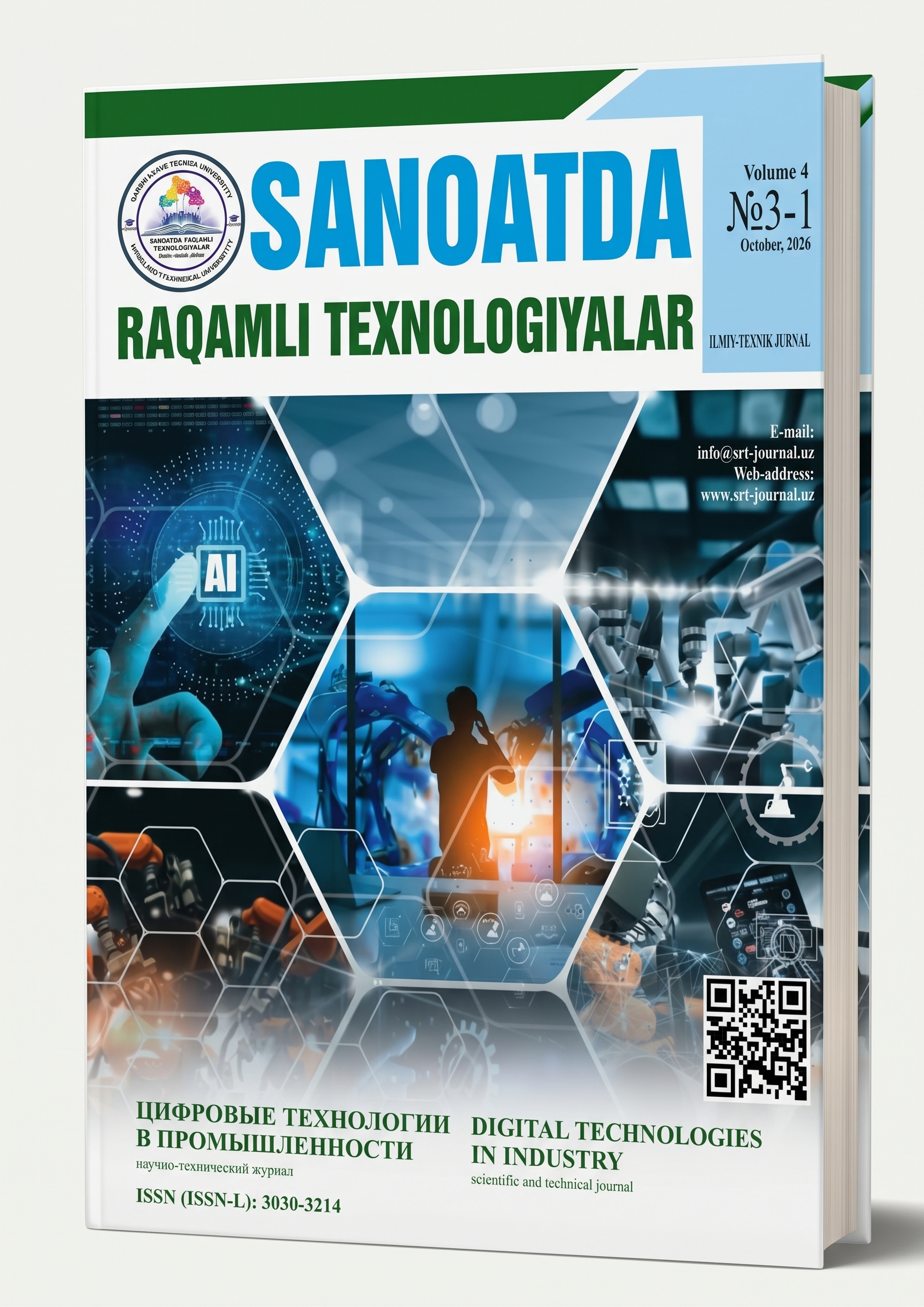
Main Article Content
Abstract
This study investigates the hydrochloric acid dissolution behavior of lignite coal ash from Angren Thermal Power Plant JSC based on thermodynamic analysis. The Gibbs free energy and enthalpy changes of the relevant reactions were calculated, and the stability and reactivity of oxide phases in the leaching system were evaluated as a function of temperature. The results indicate that oxides such as CaO, MgO, Fe₂O₃, MnO, PbO, ZnO, and CuO are soluble in HCl and preferentially transfer into the liquid phase, whereas Al₂O₃, TiO₂, ZrO₂, Nb₂O₅, MoO₃, WO₃, and GeO₂ exhibit refractory behavior and predominantly remain in the solid residue. According to the calculations, approximately 23.18% of the coal ash components can dissolve into the solution, while 76.82% remain in the solid phase. The accumulation of refractory oxides in the solid residue, particularly GeO₂, creates favorable conditions for the subsequent recovery of germanium through high-temperature processing. The obtained results provide a scientific basis for developing a staged hydrochloric acid leaching process aimed at selectively dissolving soluble oxide phases, concentrating germanium, and recovering valuable metals from coal ash as a technogenic secondary resource.
Downloads
Article Details
Section

This work is licensed under a Creative Commons Attribution 4.0 International License.
Public License Terms
(For Open Journal Systems (OJS))
-
Copyright:
The copyright of the published article remains with the author(s). However, after publication, the article is distributed on the OJS platform under the Creative Commons (CC BY) license. -
License Type:
This article is distributed under the Creative Commons Attribution 4.0 International (CC BY 4.0) license. This means users can utilize the article under the following conditions:- Copy and distribute: The text of the article or its parts can be freely distributed.
- Quote and analyze: Parts of the article can be used for quoting and analysis.
- Free use: The article can be freely used for research and educational purposes.
- Attribution: Users must provide proper attribution and reference to the original source.
-
Commercial use:
The article can be used for commercial purposes, provided that authorship and source are properly cited. -
Document modification:
The text or content of the article can be modified or adapted, as long as it does not harm the authorship. -
Liability disclaimer:
The author(s) are responsible for the accuracy of the information contained in the article. The editorial team of the platform is not liable for any damages resulting from the use of this information. -
Public usage obligations:
The content of the article must be used only in accordance with legal and ethical standards. Unauthorized use is strictly prohibited.
Note:
These license terms are designed to ensure transparency and openness in material usage. By accepting these terms, you agree to the adaptation and distribution of the article content under the terms of the Creative Commons license.
Link: Creative Commons Attribution 4.0 International (CC BY 4.0)
How to Cite
References
[1] Arroyo, F., & Fernández-Pereira, C. (2008). Hydrometallurgical recovery of germanium from coal gasification fly ash: Solvent extraction method. Industrial & Engineering Chemistry Research, 47(9), 3186–3191. https://doi.org/10.1021/ie7016948 DOI: https://doi.org/10.1021/ie7016948
[2] Rudnik, E. (2025). Challenges and opportunities in hydrometallurgical recovery of germanium from coal by-products. Molecules, 30(8), 1695. https://doi.org/10.3390/molecules30081695 DOI: https://doi.org/10.3390/molecules30081695
[3] Xu, D., Chen, Y. W., Guo, H., Liu, H. Q., Xue, Y. D., Zhang, W. F., & Sun, Y. C. (2013). Review of germanium recovery technologies from coal. Applied Mechanics and Materials, 423–426, 565–573. https://doi.org/10.4028/www.scientific.net/AMM.423-426.565 DOI: https://doi.org/10.4028/www.scientific.net/AMM.423-426.565
[4] Stadnichenko, T. M. (1953). Concentration of germanium in the ash of American coals. U.S. Geological Survey. DOI: https://doi.org/10.3133/cir272
[5] Yang, R. va boshqalar. Siz bergan ma’lumotda maqolaning to‘liq bibliografik ma’lumotlari yetarli emas. Qidiruvda aynan shu mavzuga mos ish “Extraction of Germanium from Low-Grade Germanium-Bearing Lignite by Reductive Volatilization” nomi bilan uchradi, lekin siz bergan mualliflar va jurnal ma’lumotlari bilan to‘liq mosligini ishonchli tasdiqlab bo‘lmadi. Shuning uchun APA 7 ko‘rinishida to‘liq ma’lumotni taxminan to‘ldirmayman.
[6] You, J. va boshqalar. (2025). Co-extraction and enrichment of Ge, Sb and As from coal fly ash. — Siz bergan “Journal Name” haqiqiy jurnal nomi emas. Qidiruvda 2025-yilgi mos ish “Co-extraction and enrichment of Ge, Sb and As from coal measure germanium-containing dust by reductive volatilization” nomi bilan Separation and Purification Technology, 376, 134156 sifatida topildi. https://doi.org/10.1016/j.seppur.2025.134156 DOI: https://doi.org/10.1016/j.seppur.2025.134156
[7] Bo, W., Wu, J., Miao, Z., & Wan, K. (2024). Germanium extraction from lignite using gravity separation combined with low-temperature sintering and chlorinated distillation. Separation and Purification Technology, 329, 125215. https://doi.org/10.1016/j.seppur.2023.125215 DOI: https://doi.org/10.1016/j.seppur.2023.125215